Scoliosis is a spinal condition in which the spine curves sideways in an abnormal “S” or “C” shape when viewed from behind. While the human spine naturally has gentle curves when viewed from the side, any sideways curvature beyond a certain degree is considered abnormal. Understanding the causes of scoliosis is essential for early detection, appropriate treatment, and preventing progression especially in children and adolescents.
Scoliosis can affect people of all ages, from infants to older adults. In some cases, it remains mild and causes little discomfort. In others, it may progress and lead to pain, posture changes, breathing issues, or functional limitations. This blog explains the causes of scoliosis in a clear, factual, and medically accurate way, without myths or assumptions.
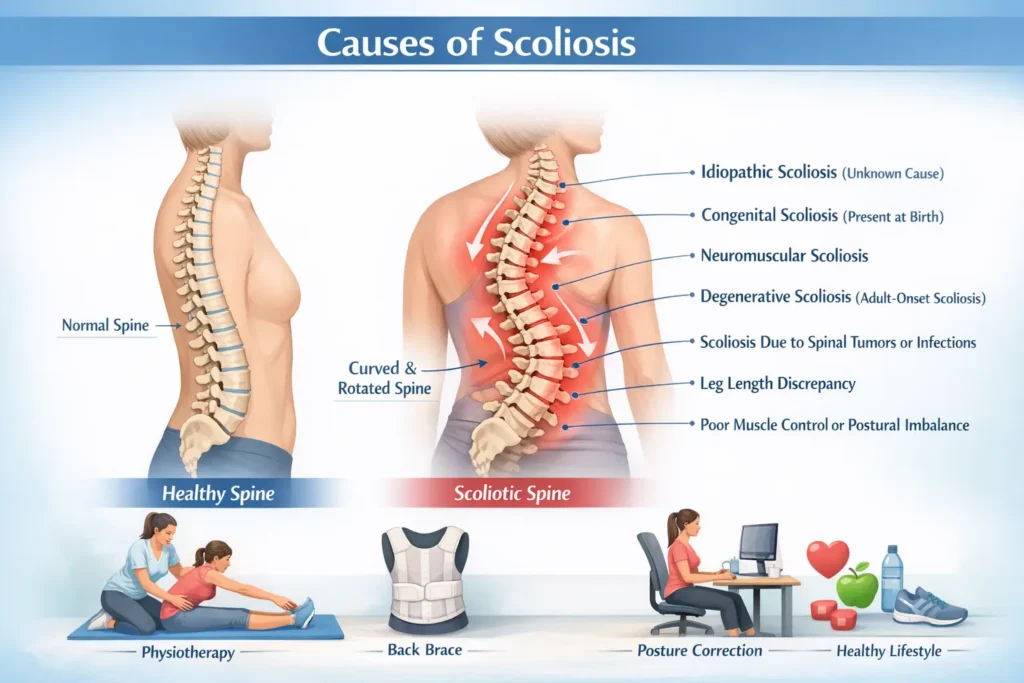
What Is Scoliosis?
Scoliosis is defined as a lateral (sideways) curvature of the spine measuring more than 10 degrees, confirmed through X-ray imaging. The curvature may involve:
- The thoracic spine (upper and mid-back)
- The lumbar spine (lower back)
- Both regions together
Scoliosis is not just a cosmetic issue. In progressive cases, spinal rotation, muscle imbalance, and altered biomechanics can affect posture, mobility, and quality of life.
Primary Causes of Scoliosis
The causes of scoliosis vary based on age, spinal development, muscle control, and underlying medical conditions. Below are the most recognized causes, explained in detail.
1. Idiopathic Scoliosis (Most Common Cause)
Key characteristics:
- Most commonly appears during adolescence (ages 10–18)
- More common in girls than boys
- Often detected during growth spurts
- May progress rapidly during puberty
Idiopathic scoliosis is most commonly diagnosed during growth spurts, particularly in cases of scoliosis in children.
What causes idiopathic scoliosis?
Despite extensive research, the exact cause remains unknown. However, studies suggest possible links to:
- Genetic predisposition
- Abnormal spinal growth patterns
- Hormonal factors
- Neuromuscular control differences
It is important to understand that idiopathic scoliosis is NOT caused by poor posture, carrying heavy school bags, sleeping positions, or lack of exercise.
2. Congenital Scoliosis (Present at Birth)
Congenital scoliosis develops due to abnormal formation of the spine during early pregnancy, usually within the first 6–8 weeks of fatal development.
How congenital scoliosis occurs:
- Some vertebrae may not form completely (hemivertebra)
- Vertebrae may be fused together
- Uneven growth leads to spinal curvature
Key points:
- Present at birth, though may be detected later
- Often associated with kidney or heart abnormalities
- Curve may worsen as the child grows
Because congenital scoliosis results from structural defects, it often requires close monitoring and, in some cases, surgical management.
3. Neuromuscular Scoliosis
Neuromuscular scoliosis occurs due to poor muscle control or muscle weakness, which prevents the spine from being properly supported.
Common conditions associated with neuromuscular scoliosis:
- Cerebral palsy
- Muscular dystrophy
- Spinal cord injury
- Polio
- Spina bifida
Why it develops:
- Weak or imbalanced muscles pull the spine unevenly
- Poor trunk control causes progressive curvature
- Curves often worsen over time
Neuromuscular scoliosis is typically more severe and progressive than idiopathic scoliosis and often affects sitting balance and mobility.
4. Degenerative Scoliosis (Adult-Onset Scoliosis)
Degenerative scoliosis develops in adults, usually after the age of 40–50, due to age-related changes in the spine.
Major contributing factors:
- Disc degeneration
- Facet joint arthritis
- Ligament laxity
- Osteoporosis
- Spinal instability
As discs lose height and joints wear out unevenly, the spine may gradually curve sideways. This form of scoliosis is often associated with chronic back pain, stiffness, and nerve compression.
5. Scoliosis Due to Leg Length Discrepancy
When one leg is shorter than the other, the pelvis tilts to compensate. Over time, this can lead to a functional scoliosis.
Important points:
- The spine curves to maintain balance
- Curve may disappear when sitting or lying down
- Often improves with shoe lifts or leg-length correction
This type is not a true structural scoliosis and is usually reversible once the underlying cause is corrected.
6. Scoliosis Caused by Spinal Tumors or Infections
Although rare, scoliosis can develop due to serious underlying spinal conditions.
Possible causes include:
- Spinal tumors
- Vertebral infections (osteomyelitis, discitis)
- Inflammatory spinal diseases
These conditions may weaken spinal bones or alter alignment, causing abnormal curvature. Sudden onset scoliosis accompanied by pain, fever, or neurological symptoms should always be evaluated urgently.
7. Postural and Muscle Imbalance Factors
Long-standing muscle imbalance or poor neuromuscular control may contribute to spinal asymmetry, particularly when combined with growth spurts or other risk factors.
Important clarification:
- Poor posture alone does NOT cause structural scoliosis
- However, it may worsen existing curves or cause postural scoliosis
Postural scoliosis typically improves with posture correction and physiotherapy.
When Should Scoliosis Be Evaluated
Medical evaluation is recommended if:
- One shoulder appears higher than the other
- Uneven hips or waistline is noticed
- One shoulder blade protrudes
- Clothes fit unevenly
- Back pain or stiffness develops
Early evaluation by spine specialists is important to identify the cause of scoliosis and monitor the risk of progression. If signs of spinal curvature are noticed early, it is advisable to connect with our team for proper medical evaluation.
Why Identifying the Cause of Scoliosis Matters
Knowing the underlying cause helps determine:
- Risk of progression
- Appropriate treatment approach
- Need for observation, bracing, or surgery
- Long-term prognosis
Understanding the underlying cause helps doctors plan the most appropriate scoliosis treatment for long-term spinal health.
Causes of Scoliosis by Age Group
In Children and Adolescents:
- Idiopathic scoliosis (most common)
- Congenital scoliosis
- Neuromuscular causes
In Adults:
- Degenerative scoliosis
- Progression of untreated childhood scoliosis
- Osteoporosis-related spinal changes
Understanding age-related causes helps guide diagnosis and treatment planning.
Common Myths About the Causes of Scoliosis
1. Heavy school bags cause scoliosis
False – They may cause back pain but do not cause structural scoliosis.
2. Bad posture causes scoliosis
False – Poor posture does not cause true scoliosis.
3. Exercise can cause scoliosis
False – Exercise does not cause scoliosis and is often beneficial.
Understanding these myths helps reduce unnecessary fear and misinformation.
Final Thoughts
The causes of scoliosis are varied and complex, ranging from unknown developmental factors to congenital abnormalities, neuromuscular conditions, and age-related degeneration. While many casese specially idiopathic scoliosis have no clearly identifiable cause, early recognition and proper evaluation play a critical role in managing the condition effectively.
Scoliosis is not caused by lifestyle habits, posture, or daily activities. With timely diagnosis and appropriate care, most individuals with scoliosis can lead active, functional lives. If spinal asymmetry or symptoms are noticed, consulting a spine specialist is the most important first step. At We Are Spine, scoliosis care focuses on accurate diagnosis, evidence-based treatment, and long-term spine health.
Frequently Asked Questions (FAQs)
What is the main cause of scoliosis?
The main cause of scoliosis in most cases is idiopathic, which means the exact reason is unknown. Researchers believe genetics play a role because scoliosis often runs in families. In some cases, scoliosis can also develop due to congenital spine malformations present at birth or as a result of neuromuscular conditions like cerebral palsy or muscular dystrophy.
What is the most common way to get scoliosis?
The most common form is adolescent idiopathic scoliosis, which typically develops gradually during a child’s growth spurt between ages 10 and 15. Most people do not notice symptoms at first, and the curvature of the spine may only be detected during routine school or pediatric checkups. Environmental factors and spinal growth patterns may also contribute.
Can scoliosis get cured?
Scoliosis usually cannot be completely cured, especially in idiopathic cases. However, treatments such as bracing, physical therapy, or corrective surgery can stop the curvature from worsening, relieve pain, and improve posture and spinal alignment. Early detection increases the effectiveness of non-surgical treatments and reduces the risk of severe curvature in adulthood.
What causes scoliosis in teens?
In teenagers, scoliosis often appears during rapid growth periods. While the exact cause is unknown in most idiopathic cases, abnormal spinal development, inherited genetic factors, and hormonal changes during puberty may contribute. Teen scoliosis may also be influenced by muscle imbalances or differences in leg length, which can affect spinal alignment over time.
What age is scoliosis most common?
Scoliosis is most frequently diagnosed in children and adolescents aged 10–15, which is when rapid growth occurs. Early detection during this period is critical because interventions like bracing are most effective before skeletal maturity. Adult scoliosis can also develop, usually due to degenerative changes, but adolescent scoliosis is far more common.