

First symptoms of spinal cancer
Spinal cancer is a rare but serious condition that occurs when abnormal cells grow within the spine or spinal cord. It may originate in the spine itself (primary spinal cancer) or spread from another part of the body (secondary or metastatic spinal cancer). One of the biggest challenges with spinal cancer is that early symptoms are often subtle and easily mistaken for common back problems.
Understanding the first symptoms of spinal cancer is critical for early diagnosis, timely treatment, and better outcomes. This blog explains the early warning signs in a clear, factual, and medically accurate way.
What Is Spinal Cancer?
Spinal cancer refers to tumors that develop in or around:
- The vertebrae (spinal bones)
- The spinal cord
- Spinal nerves
- Surrounding tissues
Spinal cancer is often referred to clinically as a spine tumour treatment, which may develop within the spinal cord, vertebrae, or surrounding tissues. Tumors may be benign (non-cancerous) or malignant (cancerous). Even benign tumors can cause serious problems if they compress the spinal cord or nerves.
Why Early Symptoms Are Often Missed
In the early stages, spinal cancer symptoms may resemble:
- Muscle strain
- Degenerative spine disease
- Disc problems
- Age-related back pain
Early spinal cancer symptoms are sometimes mistaken for age-related conditions such as cervical spondylosis, especially when neck pain and stiffness are present. Chronic back pain related to spinal cancer is sometimes wrongly attributed to osteoarthritis, particularly in older adults.
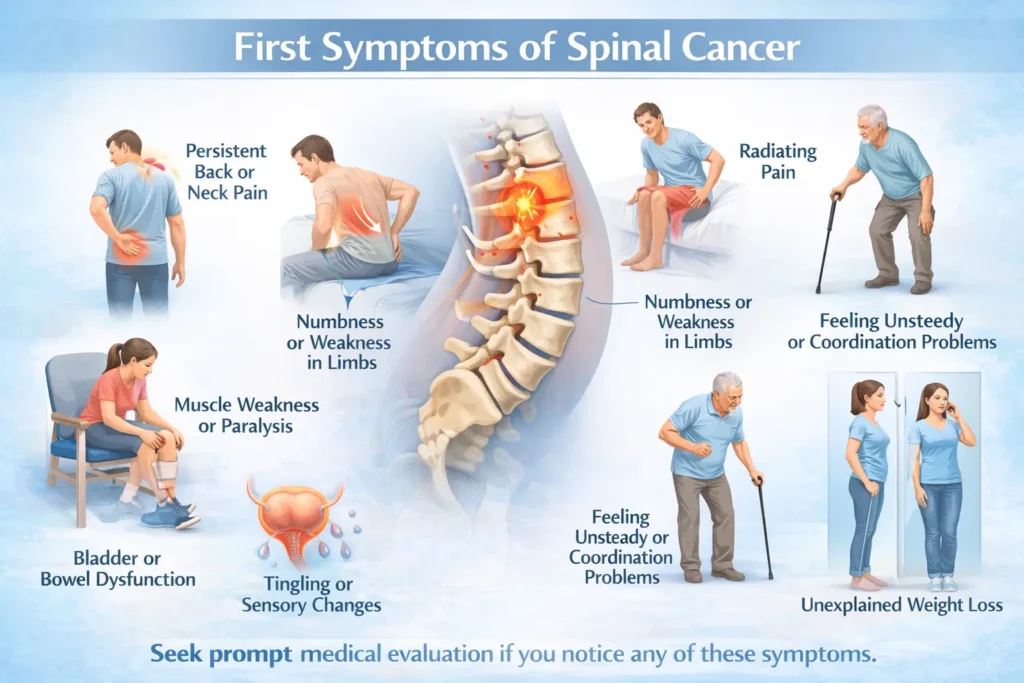
First Symptoms of Spinal Cancer
1. Persistent Back Pain That Does Not Improve
The most common and earliest symptom of spinal cancer is persistent back pain.
Red flags include:
- Pain that lasts for weeks or months
- Pain that does not improve with rest or medication
- Pain that worsens over time
- Pain that is more severe at night or wakes you from sleep
Unlike mechanical back pain, cancer-related pain is often deep, constant, and progressive. Persistent back pain related to spinal tumors is often misdiagnosed initially as a slipped disc due to overlapping pain patterns. Inflammatory back pain caused by spinal tumors may mimic symptoms of ankylosing spondylitis, especially when stiffness is worse at night.
2. Night Pain or Pain at Rest
Back pain that becomes worse at night or while lying down is an important warning sign.
This occurs because:
- Tumor-related inflammation increases at rest
- Pressure on spinal structures is constant, not movement-related
Night pain should always be medically evaluated, especially when it is persistent.
3. Unexplained Weight Loss and Fatigue
Systemic symptoms may appear early, particularly in malignant or metastatic spinal cancer.
These include:
- Unintentional weight loss
- Persistent fatigue
- Loss of appetite
- General weakness
These symptoms suggest that the body is under stress from an underlying disease process.
4. Numbness, Tingling, or Altered Sensation
As a spinal tumor grows, it may compress nearby nerves or the spinal cord.
Early neurological symptoms include:
- Tingling or pins-and-needles sensation
- Numbness in the arms, hands, legs, or feet
- Sensory changes on one side or both sides of the body
These symptoms often start mildly and worsen gradually. Nerve compression from a spinal tumor can cause leg pain and tingling similar to sciatica.
5. Weakness in the Arms or Legs
Muscle weakness is a serious early sign of spinal cord or nerve compression.
You may notice:
- Difficulty gripping objects
- Trouble lifting arms
- Weak or heavy legs
- Difficulty climbing stairs
Progressive compression of the spinal cord can lead to symptoms similar to a spinal cord injury, including weakness and loss of coordinati
6. Difficulty Walking or Balance Problems
Spinal cancer affecting the spinal cord can disrupt coordination and balance.
Early signs include:
- Unsteady walking
- Frequent stumbling
- Loss of coordination
- Feeling of stiffness or heaviness in the legs
Gait imbalance caused by spinal tumors may resemble symptoms seen in spinal stenosis, leading to delayed diagnosis.
7. Changes in Bladder or Bowel Function
Although this usually occurs in more advanced stages, it can sometimes appear early and should be treated as a medical emergency.
Warning signs include:
- Difficulty controlling urination
- Urinary retention
- Bowel incontinence
- Numbness in the groin or saddle area
These symptoms indicate significant spinal cord compression.
First Symptoms of Spinal Cancer vs Common Back Pain
| Feature | Common Back Pain | Spinal Cancer Pain |
|---|---|---|
| Improves with rest | Yes | No |
| Worse at night | Rare | Common |
| Progressive | No | Yes |
| Neurological symptoms | Rare | Common |
| Associated weight loss | No | Possible |
When to See a Doctor Immediately
Seek medical evaluation if you experience:
- Persistent back pain lasting more than a few weeks
- Back pain with night worsening
- Numbness, weakness, or balance issues
- Unexplained weight loss
- Bladder or bowel changes
Early imaging and diagnosis can prevent permanent neurological damage. If you notice persistent back pain, weakness, or numbness, it is important to speak with our spine experts for a timely evaluation.
How Is Spinal Cancer Diagnosed?
Diagnosis may involve:
- MRI of the spine
- CT scan or X-rays
- Blood tests
- Biopsy (if needed)
Early diagnosis significantly improves treatment options and outcomes.
Final Thoughts
The first symptoms of spinal cancer are often subtle and easily overlooked. Persistent back pain, night pain, unexplained weight loss, numbness, weakness, and balance problems should never be ignored especially when they worsen over time.
While spinal cancer is rare, early recognition of warning signs and prompt medical evaluation are crucial. If symptoms feel unusual, persistent, or progressive, seeking timely medical advice can make a life-changing difference.
Frequently Asked Questions (FAQs)
What are the first signs of spinal cancer?
Early signs may include persistent back pain, numbness or tingling in the limbs, weakness, and difficulty walking. Pain is often worse at night or does not improve with rest.
Can spinal cancer be cured?
Treatment depends on the type, location, and stage. Some spinal cancers can be cured with surgery, radiation, or chemotherapy, while others can be controlled to relieve symptoms and slow progression.
What age do people get spinal tumors?
Spinal tumors can occur at any age, but they are most commonly diagnosed in adults between 40 and 70. Certain types are more common in children or younger adults.
Would spinal cancer show in a blood test?
There is no routine blood test that confirms spinal cancer. Blood tests may show signs of inflammation or organ effects, but imaging tests like MRI or CT scans are required for diagnosis.
Does spinal cancer spread fast?
The growth rate depends on the tumor type. Some spinal cancers grow slowly, while others, such as metastatic tumors, can spread quickly to nearby tissues or other organs.