16 Best Exercises for Desk Workers to Fix Posture & Relieve Pain
Sitting all day is quietly damaging your body but the right movement routine can reverse much of the stiffness, pain, and posture decline caused by desk jobs.
If you spend 6–12 hours daily at a computer, your neck, shoulders, hips, spine, wrists, and core are under constant stress. Over time, this can lead to:
- Neck stiffness
- Rounded shoulders
- Upper back tightness
- Lower back pain
- Tight hip flexors
- Weak glutes
- Wrist strain from typing
- Reduced mobility and energy
- Poor posture and spinal fatigue
The good news?
You do not need an intense gym routine to protect your spine.
The best exercises for desk workers are short, targeted mobility and strengthening movements that restore posture, improve circulation, activate weak muscles, and reduce the harmful effects of prolonged sitting.
This guide covers:
- The best stretches for office workers
- Desk job back pain relief exercises
- Posture correction exercises
- Neck stretches at work
- Hip mobility exercises
- Wrist exercises for typing
- A 5-minute desk workout
- A 15-minute daily mobility plan
- Mistakes most desk workers make
- Evidence-based posture recovery strategies
Quick Answer: What Are the Best Exercises for Desk Workers?
The best exercises for desk workers include:
- Chin tucks
- Cat-cow stretch
- Thoracic extensions
- Hip flexor stretch
- Glute bridges
- Shoulder blade squeezes
- Wrist mobility drills
- Planks
- Standing back extensions
- Walking breaks every 30–60 minutes
These exercises help counteract:
- Forward head posture
- Rounded shoulders
- Tight hips
- Weak glutes
- Spinal compression
- Poor circulation caused by sitting all day
Why Desk Jobs Damage the Body
Humans are designed for movement not prolonged sitting.
When you remain seated for hours:
- Hip flexors shorten
- Glutes become inactive
- Core muscles weaken
- The thoracic spine stiffens
- Neck muscles overwork
- Blood circulation slows
- Spinal discs experience continuous pressure
This creates the classic “desk worker posture”:
- Forward head
- Rounded shoulders
- Tight chest
- Weak upper back
- Anterior pelvic tilt
- Lower back strain
Over time, this may contribute to:
- Cervical spondylosis
- Lumbar pain
- Sciatica
- Disc problems
- Repetitive strain injuries
- Chronic stiffness
Effects of Prolonged Sitting on the Body
Body Area | Common Problem | Why It Happens |
Neck | Forward head posture | Screen positioning |
Shoulders | Rounded shoulders | Tight chest muscles |
Upper back | Stiff thoracic spine | Lack of movement |
Lower back | Disc pressure | Poor sitting posture |
Hips | Tight hip flexors | Constant seated position |
Glutes | Weakness (“dead butt syndrome”) | Muscle inactivity |
Wrists | Typing strain | Repetitive motion |
Core | Weakness | Reduced activation |
How Often Should Desk Workers Stretch?
Most physiotherapists recommend:
- Movement breaks every 30–60 minutes
- Stretching 2–4 times daily
- At least 15–30 minutes of total movement daily
Even brief movement snacks improve:
- Blood circulation
- Posture awareness
- Joint lubrication
- Muscle activation
- Energy and focus
Best Exercises for Desk Workers by Body Part
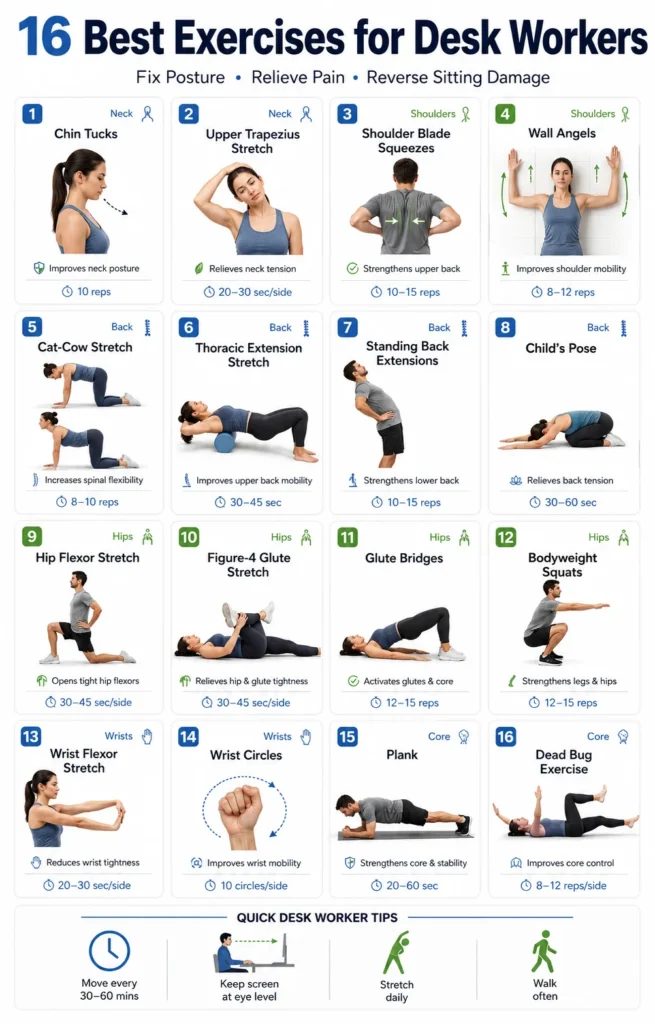
Neck Exercises for Desk Workers
1. Chin Tucks
What It Helps
- Forward head posture
- Neck stiffness
- Tension headaches
- Cervical strain
How to Do It
- Sit upright
- Pull your chin backward gently
- Keep eyes level
- Hold for 5 seconds
- Repeat 10 times
Duration/Reps
- 2 sets of 10 reps
Common Mistakes
- Tilting the head down
- Forcing the movement
Beginners Modification
Perform against a wall for posture support.
Who Should Avoid It
Avoid aggressive motion if you have severe cervical pain or dizziness.
2. Upper Trapezius Stretch
What It Helps
- Tight neck muscles
- Shoulder tension
- Stress-related stiffness
Steps
- Sit tall
- Tilt head sideways
- Use opposite hand gently
- Hold 20–30 seconds
Reps
- 2–3 per side
Mistakes
- Pulling too hard
- Shrugging shoulders
Shoulder Mobility Exercises
3. Shoulder Blade Squeezes
Benefits
- Improves posture
- Activates upper back muscles
- Reduces rounded shoulders
Steps
- Sit or stand tall
- Pull shoulder blades backward
- Hold 5 seconds
- Relax slowly
Reps
- 15 repetitions
Common Mistakes
- Arching lower back
- Lifting shoulders upward
4. Wall Angels
Helps
- Thoracic mobility
- Posture correction
- Shoulder mobility
Instructions
- Stand against wall
- Keep arms in “goalpost” position
- Slide arms upward slowly
- Maintain contact with wall
Reps
- 10 repetitions
Beginners Tip
Reduce range if shoulders feel tight.
Upper Back Stretches for Office Workers
5. Cat-Cow Stretch
Benefits
- Improves spinal mobility
- Relieves stiffness
- Enhances circulation
Steps
- Start on hands and knees
- Arch spine upward
- Then lower belly and lift chest
- Move slowly with breathing
Reps
- 10–15 repetitions
Mistakes
- Moving too fast
- Holding breath
6. Thoracic Extension Stretch
What It Helps
- Rounded posture
- Upper back stiffness
- Desk-related slouching
Instructions
- Sit on chair
- Place hands behind head
- Lean upper back gently backward
- Hold briefly
Reps
- 10 repetitions
Lower Back Pain Relief Exercises
7. Standing Back Extensions
Helps
- Lumbar stiffness
- Disc pressure from sitting
- Lower back fatigue
Steps
- Stand upright
- Place hands on hips
- Lean backward gently
- Return slowly
Reps
- 10 repetitions every few hours
Avoid If
Pain shoots down the leg.
8. Child’s Pose
Benefits
- Gentle spinal decompression
- Relaxation
- Lower back stretching
Hold
- 30–60 seconds
Beginners Tip
Place pillow under hips if uncomfortable.
Hip Mobility Exercises for Desk Workers
9. Hip Flexor Stretch
Why It Matters
Sitting shortens hip flexors, pulling the pelvis forward and stressing the lower back.
Steps
- Kneel on one knee
- Shift hips forward
- Keep chest upright
- Hold stretch
Duration
- 30 seconds each side
Common Mistakes
- Leaning forward excessively
- Overarching lower back
10. Figure-4 Glute Stretch
Helps
- Tight hips
- Piriformis tension
- Sciatic irritation
Steps
- Sit on chair
- Cross ankle over opposite knee
- Lean forward slightly
Hold
- 20–30 seconds
Glute Activation Exercises
11. Glute Bridges
Benefits
- Activates weak glutes
- Supports lower back
- Improves pelvic stability
Instructions
- Lie on back
- Bend knees
- Lift hips upward
- Squeeze glutes
Reps
- 12–15 repetitions
Mistakes
- Using lower back excessively
- Rushing the movement
12. Bodyweight Squats
Helps
- Improve circulation
- Strengthen hips and legs
- Reverse prolonged sitting stiffness
Reps
- 10–15 repetitions
Beginners Tip
Use chair support if needed.
Wrist Exercises for Typing and Computer Users
13. Wrist Flexor Stretch
Pain in upper left back is a common condition that may develop because of muscle strain, poor posture, cervical spine problems, stress, or degenerative changes in the spine. While many cases improve with rest, posture correction, exercises, and physiotherapy, persistent symptoms should not be ignored.
Benefits
- Reduces typing strain
- Improves forearm flexibility
- Helps prevent repetitive strain injury
Steps
- Extend arm forward
- Pull fingers backward gently
- Hold stretch
Duration
- 20 seconds
14. Wrist Circles
Helps
- Joint lubrication
- Mobility
- Blood circulation
Reps
- 10 circles each direction
Core Strengthening for Desk Workers
15. Plank
Why It Matters
Weak core muscles increase spinal stress during sitting.
Instructions
- Keep body straight
- Engage core
- Avoid sagging hips
Duration
- 20–45 seconds
Beginners Modification
Start with knee plank.
16. Dead Bug Exercise
Benefits
- Core stability
- Lumbar support
- Coordination
Reps
- 10 per side
Standing Desk Exercises
If you use a standing desk, movement still matters.
Best Standing Desk Exercises
- Calf raises
- Marching in place
- Shoulder rolls
- Mini squats
- Standing hip circles
Standing alone does not eliminate posture problems.
5-Minute Desk Workout Routine
Exercise | Duration |
Chin tucks | 30 sec |
Shoulder rolls | 30 sec |
Cat-cow stretch | 45 sec |
Hip flexor stretch | 45 sec |
Wrist stretches | 30 sec |
Glute squeezes | 30 sec |
Standing back extensions | 30 sec |
Walking | 1 minute |
This quick office workout routine can dramatically reduce stiffness during workdays.
15-Minute Daily Mobility Plan for Office Workers
Time | Exercise |
2 min | Neck mobility |
2 min | Shoulder mobility |
2 min | Thoracic stretches |
3 min | Hip mobility exercises |
2 min | Glute activation |
2 min | Core exercises |
2 min | Walking cooldown |
Best Exercises by Pain Area
Symptom | Best Exercise |
Neck stiffness | Chin tucks |
Rounded shoulders | Wall angels |
Upper back tightness | Thoracic extensions |
Lower back pain | Back extensions |
Tight hips | Hip flexor stretch |
Weak glutes | Glute bridges |
Wrist strain | Wrist flexor stretch |
Poor posture | Shoulder blade squeezes |
What Exercises Reverse Sitting Posture?
The most effective posture correction exercises include:
- Chin tucks
- Thoracic extensions
- Wall angels
- Hip flexor stretches
- Glute bridges
- Core strengthening exercises
These exercises target the muscle imbalances created by prolonged sitting.
Can Exercise Undo Years of Sitting?
Yes partially.
The body adapts remarkably well to consistent movement.
Most desk workers notice:
- Reduced stiffness within 1–2 weeks
- Improved posture awareness within 3–6 weeks
- Better mobility within 1–2 months
- Strength improvements within 8–12 weeks
However, severe spinal degeneration may require physiotherapy or medical treatment.
What Is the Best Stretch After Sitting All Day?
The hip flexor stretch is one of the best stretches after prolonged sitting because it:
- Opens tight hips
- Reduces lower back strain
- Improves posture
- Restores pelvic alignment
Combining it with thoracic extension stretches provides even better results.
Exercises Desk Workers Should Avoid
Some exercises may worsen pain if posture issues already exist.
Avoid:
- Heavy deadlifts with poor form
- Deep sit-ups causing neck strain
- Aggressive toe touches
- Excessive neck rolling
- High-impact jumping with severe back pain
If symptoms worsen, stop immediately.
Common Mistakes Desk Workers Make
1. Sitting Too Long Without Breaks
Even perfect posture becomes harmful if maintained for hours.
2. Stretching Without Strengthening
Mobility alone is not enough. Weak muscles must be strengthened.
3. Ignoring Hip Mobility
Tight hips are a major driver of back pain.
4. Poor Ergonomic Setup
Exercises cannot fully compensate for poor workstation ergonomics.
Myth vs Fact: Desk Worker Fitness
Myth | Fact |
Sitting upright all day fixes posture | Movement matters more |
Standing desks solve everything | Standing too long also stresses the body |
Stretching alone prevents pain | Strengthening is equally important |
Back pain means you should rest completely | Controlled movement usually helps |
Symptom-Based Recommendations
Symptom | Recommended Focus |
Neck pain | Chin tucks + ergonomic corrections |
Tight shoulders | Wall angels + chest stretching |
Lower back pain | Core strengthening + hip mobility |
Tingling wrists | Wrist mobility + typing ergonomics |
Tight hips | Hip flexor stretching + walking |
Fatigue | Movement breaks + circulation exercises |
Posture Checklist for Desk Workers
Your workstation should support:
- Screen at eye level
- Feet flat on floor
- Knees at 90 degrees
- Elbows supported
- Neutral wrist position
- Relaxed shoulders
- Frequent movement breaks
When to See a Physiotherapist
Consult a physiotherapist if you experience:
- Pain lasting over 2–4 weeks
- Numbness or tingling
- Weakness in arms or legs
- Pain radiating down limbs
- Severe headaches with neck pain
- Difficulty walking
- Progressive posture worsening
Beginner vs Advanced Routine
Level | Focus |
Beginner | Mobility + posture awareness |
Intermediate | Mobility + strength |
Advanced | Strength + endurance + stability |
Standing Desk vs Sitting Desk: Which Is Better?
Neither is perfect alone.
The healthiest approach:
- Alternate sitting and standing
- Move every 30–60 minutes
- Include mobility exercises daily
Movement is more important than any single posture.
Frequently Asked Questions
What exercise is best for people who sit all day?
The best exercises for people who sit all day include chin tucks, hip flexor stretches, glute bridges, thoracic extensions, and walking breaks because they target the muscle imbalances created by prolonged sitting.
How do desk workers stay fit?
Desk workers stay fit by:
- Taking movement breaks
- Doing daily mobility routines
- Strength training 2–4 times weekly
- Walking regularly
- Improving posture and workstation ergonomics
Are standing desks enough?
No. Standing desks help reduce prolonged sitting but do not replace movement, stretching, or strengthening exercises.
Can sitting too much cause permanent damage?
Prolonged sitting may contribute to chronic pain, disc problems, reduced mobility, and postural changes. Early intervention significantly improves recovery outcomes.
What muscles get weak from sitting?
Commonly weakened muscles include:
- Glutes
- Core muscles
- Upper back muscles
- Deep neck stabilizers
How long should office workers exercise daily?
Most office workers benefit from:
- 15–30 minutes of daily exercise
- Short movement breaks every hour
- Strength training several times weekly
What is “dead butt syndrome”?
Dead butt syndrome refers to gluteal muscle inhibition caused by prolonged sitting. Symptoms may include hip tightness, lower back pain, and reduced stability.
Why do desk workers get tight hips?
Sitting keeps the hip flexors in a shortened position for long periods, causing stiffness and muscular imbalance.
Conclusion : Small Daily Movement Prevents Big Future Problems
The human body adapts to whatever you do most frequently.
If you sit all day without movement, your body gradually becomes tighter, weaker, and more painful. But if you consistently perform the best exercises for desk workers, you can dramatically improve posture, reduce stiffness, protect your spine, and feel more energetic throughout the day.
You do not need perfect posture.
You need regular movement.
Start small:
- Stretch every hour
- Walk more often
- Strengthen weak muscles
- Improve your workstation setup
- Stay consistent for weeks not days
Your spine, joints, muscles, and long-term health will thank you.



2 Responses