
Lumbar Spondylosis Exercises: Safe Exercises for Pain Relief and Better Mobility
Lumbar spondylosis is a common age-related condition involving degenerative changes in the lower spine. It may cause lower back pain, stiffness, reduced mobility, or discomfort that sometimes extends into the buttocks or legs.
Regular physical activity can play an important role in managing these symptoms. The right lumbar spondylosis exercises can help improve flexibility, strengthen muscles supporting the spine, maintain mobility, and make everyday activities easier.
However, exercise should be individualized. Lumbar spondylosis can range from mild degenerative changes to conditions involving nerve compression or spinal stenosis. An exercise that feels comfortable for one person may aggravate symptoms in another.
This guide explains exercises that may help with lumbar spondylosis, exercises to approach cautiously, and situations where professional evaluation is important.
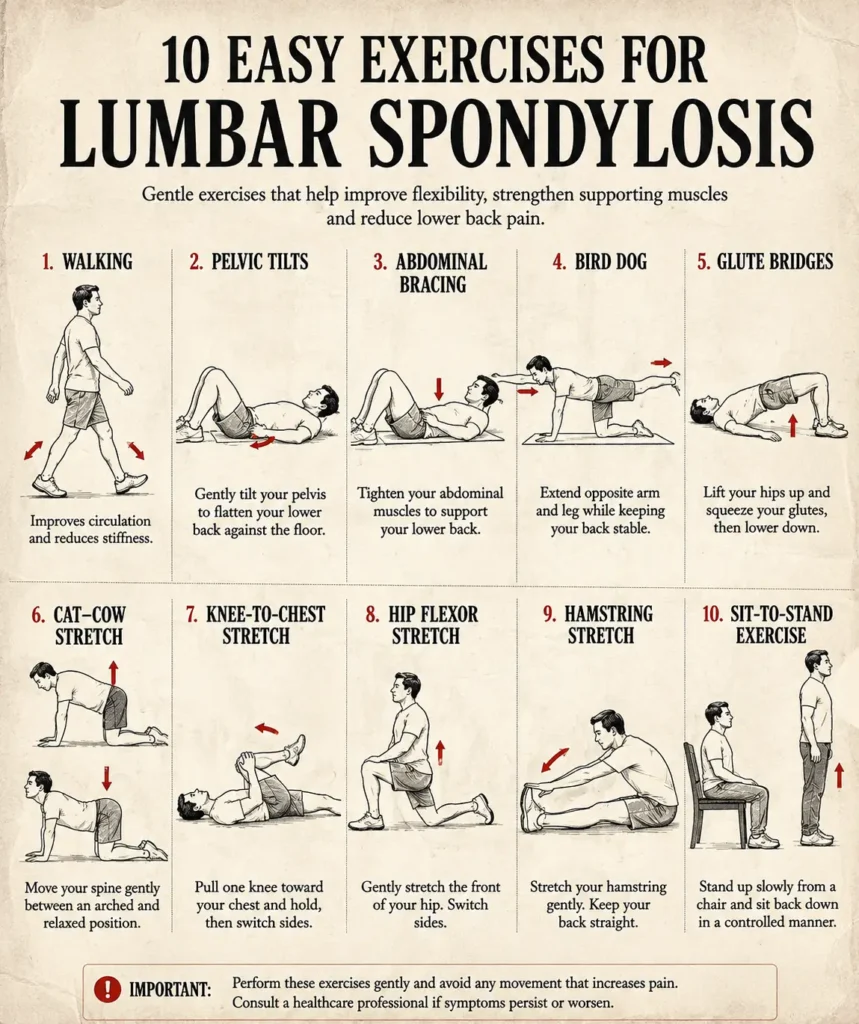
Best Lumbar Spondylosis Exercises
1. Walking
Walking is one of the simplest and most accessible forms of exercise for people with lumbar spondylosis.
It keeps the body moving without the heavy spinal loading associated with some strength exercises.
How to start:
- Begin with 5–10 minutes at a comfortable pace.
- Maintain an upright but relaxed posture.
- Increase your walking duration gradually.
- Take short movement breaks rather than remaining seated for long periods.
If walking consistently causes increasing leg pain or numbness, consult a healthcare professional.
2. Pelvic Tilts
Pelvic tilts gently mobilize the lower back and help develop awareness of abdominal and pelvic control.
How to perform:
- Lie on your back.
- Bend your knees and keep your feet flat.
- Relax your shoulders.
- Gently tighten your abdominal muscles.
- Flatten your lower back slightly toward the floor.
- Hold for a few seconds.
- Relax and return to your starting position.
Perform the movement slowly rather than forcing the spine into an extreme position.
3. Abdominal Bracing
Core strength is an important part of lumbar spondylosis exercises because the abdominal and trunk muscles help support the spine during movement.
How to perform:
Lie on your back with your knees bent.
- Keep your spine in a comfortable neutral position.
- Gently tighten your abdominal muscles.
- Continue breathing normally.
- Hold the contraction for several seconds.
- Relax.
The goal is controlled activation rather than pulling the stomach in as forcefully as possible.
4. Bird Dog
The bird dog exercise helps strengthen the core and improve spinal stability.
How to perform:
Start on your hands and knees.
Keep your spine in a comfortable neutral position.
Slowly extend one arm forward.
At the same time, extend the opposite leg backward.
Keep your hips level.
Hold briefly.
Return slowly to the starting position.
Repeat on the opposite side.
If maintaining balance is difficult, begin by moving only one limb at a time.
5. Glute Bridges
Strong gluteal muscles can help improve hip movement and reduce excessive reliance on the lower back.
How to perform:
Lie on your back.
- Bend your knees and place your feet on the floor.
- Keep your feet approximately hip-width apart.
- Gently tighten your abdominal muscles.
- Squeeze your buttocks.
- Raise your hips slowly.
- Stop when your body forms a comfortable straight line from your shoulders toward your knees.
- Lower your hips gradually.
Avoid arching your lower back excessively.
6. Cat-Cow Stretch
This gentle mobility exercise can help some people maintain movement in the lumbar spine.
How to perform:
- Begin on your hands and knees.
- Keep your hands below your shoulders.
- Keep your knees below your hips.
- Slowly round your back.
- Then gently move toward a comfortable extension.
- Repeat slowly.
Do not force either end position.
If this movement causes radiating leg pain or neurological symptoms, stop the exercise.
7. Knee-to-Chest Stretch
A gentle knee-to-chest stretch may improve lower-back flexibility for some people.
How to perform:
- Lie comfortably on your back.
- Bend one knee.
- Slowly bring it toward your chest.
- Hold the position gently.
- Return to the starting position.
- Repeat with the other leg.
You may also bring both knees toward the chest if this position is comfortable for you.
This exercise may not be appropriate for everyone, particularly if flexion worsens your symptoms.
8. Hip Flexor Stretch
Tight hip flexors can influence pelvic positioning and movement patterns.
How to perform:
- Kneel with one knee on the floor.
- Place the opposite foot in front.
- Keep your torso upright.
- Gently move your hips forward.
- Stop when you feel a mild stretch at the front of the hip.
- Hold briefly and return.
Avoid excessive arching of the lower back.
9. Hamstring Stretch
Maintaining comfortable hamstring flexibility can support normal lower-body movement.
How to perform:
Lie on your back.
- Raise one leg.
- Use a towel or strap if needed.
- Gently straighten the leg until you feel a mild stretch.
- Hold without bouncing.
- Slowly lower the leg.
The stretch should not cause sharp back pain or increasing nerve symptoms.
10. Sit-to-Stand Exercise
This functional exercise strengthens the muscles used for everyday activities.
How to perform:
Sit on a stable chair.
Place your feet comfortably on the floor.
Lean forward slightly from the hips.
Stand up using your legs.
Slowly sit back down.
Repeat using controlled movement.
Avoid using excessive momentum.
As strength improves, repetitions can gradually be increased.
Lumbar Spondylosis Exercises for Beginners
If your back is stiff or painful, you do not need to begin with an intensive exercise routine.
A simple starting program may include:
Exercise | Suggested Starting Approach |
Walking | 5–10 minutes |
Pelvic tilts | 8–10 repetitions |
Abdominal bracing | 5–10 repetitions |
Bird dog | 5 repetitions each side |
Glute bridges | 8–10 repetitions |
Gentle stretching | 15–30 seconds |
These are general examples rather than a personalized prescription.
Your physiotherapist may modify the repetitions, duration, or exercise selection according to your symptoms.
How Often Should You Do Lumbar Spondylosis Exercises?
Consistency is more important than performing an intense workout occasionally.
For many people, a combination of:
- Regular walking
- Mobility exercises
- Core strengthening
- Hip strengthening
- Gentle stretching
can form the foundation of a long-term exercise program.
Start gradually and increase the duration or repetitions as your body adapts.
If exercise causes symptoms that continue to worsen rather than settle, seek professional advice.
Conclusion
The right lumbar spondylosis exercises can help maintain spinal mobility, strengthen the muscles supporting the lower back, improve physical function, and make everyday activities more comfortable.
Walking, core strengthening, glute exercises, gentle mobility work, and appropriate stretching can form part of a long-term exercise program. However, the ideal exercises depend on the severity and pattern of your symptoms.
If you experience radiating leg pain, persistent numbness, weakness, difficulty walking, or worsening symptoms, do not rely solely on home exercises. A spine specialist or physiotherapist can assess your condition and recommend an individualized rehabilitation plan.
If lumbar spondylosis is affecting your mobility or daily life, consult a spine specialist for an accurate diagnosis and personalized treatment plan.