Lumbar Spondylosis Causes: Why Does Lumbar Spondylosis Happen?
Lumbar spondylosis is a condition involving age-related and degenerative changes in the lower part of the spine. It can affect the intervertebral discs, facet joints, vertebrae, and other structures that support the lumbar spine.
The condition is common, particularly as people get older. However, lumbar spondylosis causes are not limited to ageing alone. Genetics, previous injuries, repetitive physical stress, body weight, smoking, and certain occupational activities can also influence how quickly degenerative changes develop.
Importantly, spinal degeneration seen on an X-ray or MRI does not always mean that a person will experience pain. Some people have significant degenerative changes without symptoms, while others may develop considerable back pain or nerve-related symptoms from relatively modest changes.
Understanding the causes and risk factors can help you take steps to protect your spine and recognize when medical evaluation may be necessary.
What Is Lumbar Spondylosis?
Before discussing the causes of lumbar spondylosis, it is useful to understand what happens in the lumbar spine.
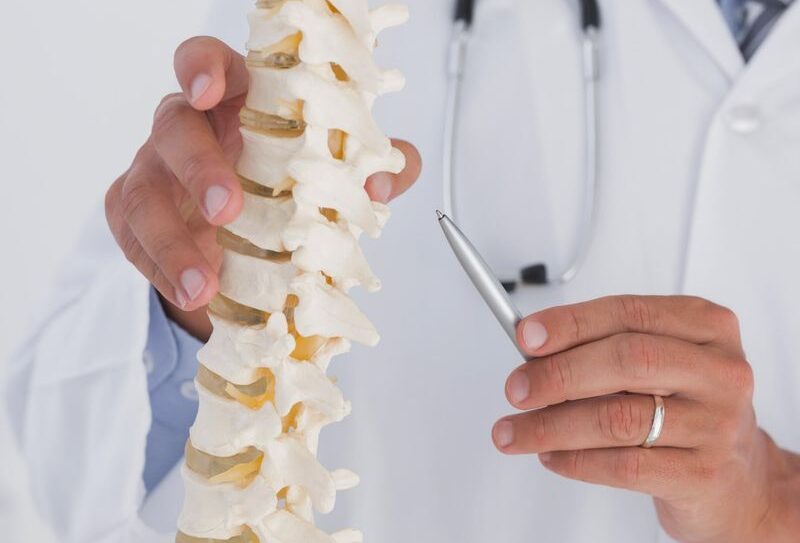
The lumbar spine consists of five vertebrae, L1 to L5. Between these vertebrae are discs that act as shock absorbers and allow the spine to move.
With ageing and repeated mechanical stress, several changes may occur:
- Intervertebral discs lose water and flexibility.
- Disc height may decrease.
- Facet joints may develop degenerative changes.
- Bone spurs, also called osteophytes, may form.
- Ligaments may become thicker.
- The spaces through which nerves travel may become narrower.
These changes collectively contribute to what is commonly called lumbar spondylosis.
Main Causes of Lumbar Spondylosis
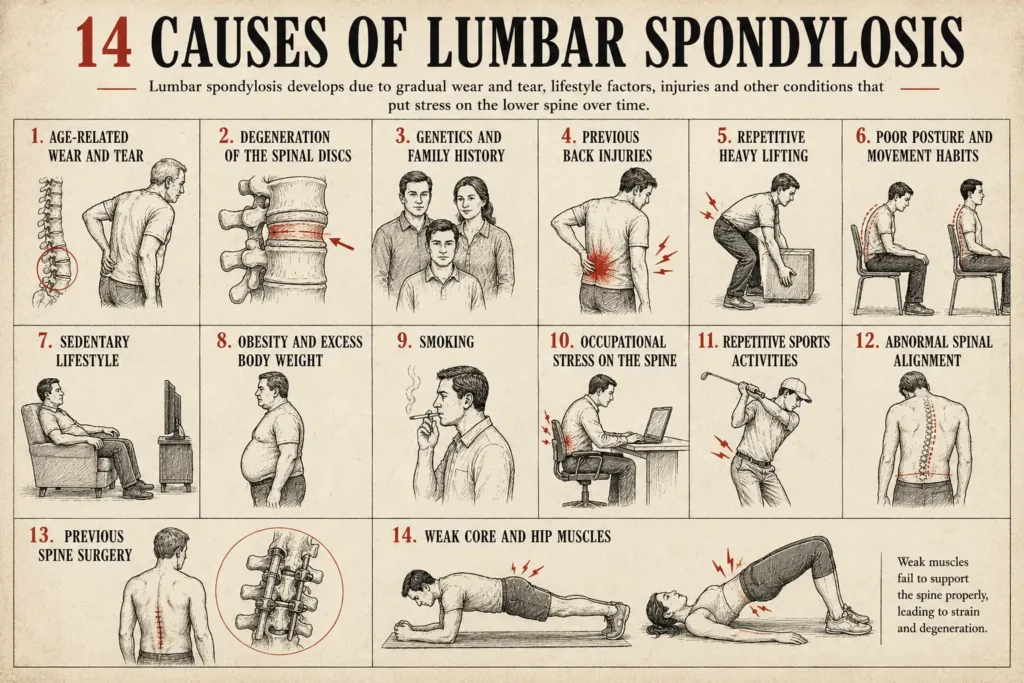
1. Age-Related Wear and Tear
Ageing is one of the most important lumbar spondylosis causes.
As we grow older, spinal discs gradually lose water and become less flexible. Their ability to absorb and distribute mechanical loads can decrease.
The facet joints can also undergo cartilage degeneration.
Over time, these changes can contribute to:
- Disc degeneration
- Joint stiffness
- Reduced spinal mobility
- Bone spur formation
- Narrowing around spinal nerves
This is why lumbar spondylosis becomes increasingly common with age.
However, ageing does not mean that back pain is inevitable.
2. Degeneration of the Spinal Discs
The discs between the vertebrae are exposed to repeated loading throughout everyday life.
With time, a disc may lose some of its hydration and elasticity. It can become thinner and less capable of distributing forces evenly.
Disc degeneration can contribute to changes in the surrounding vertebrae and facet joints.
This process is often referred to as degenerative disc disease, although disc degeneration and lumbar spondylosis are not exactly the same diagnosis.
3. Genetics and Family Historya
Genetic factors can influence how susceptible an individual is to spinal degeneration.
If close family members developed significant degenerative spine problems at a relatively young age, you may have a higher susceptibility.
Genetics can influence factors such as:
- Disc structure
- Cartilage health
- Bone characteristics
- The rate of disc degeneration
However, having a family history does not mean that you will necessarily develop painful lumbar spondylosis.
4. Previous Back Injuries
Previous injuries can contribute to degenerative changes later in life.
Examples include:
- Sports injuries
- Falls
- Road traffic accidents
- Work-related injuries
- Repeated lifting injuries
An injury may damage a disc, joint, or supporting structure and alter the way forces are distributed through the spine.
However, not every person with a previous back injury develops lumbar spondylosis.
5. Repetitive Heavy Lifting
Repeated heavy lifting can place considerable mechanical stress on the lumbar spine.
This is particularly relevant to people whose work involves frequent:
- Lifting
- Carrying
- Bending
- Pulling
- Pushing
The problem is not necessarily one episode of lifting. Repeated exposure to high physical loads over many years may contribute to degenerative changes.
Good lifting techniques and appropriate strengthening can help reduce unnecessary strain.
6. Poor Posture and Movement Habits
Poor posture is often mentioned when discussing lumbar spondylosis causes, but it is important to be precise.
Poor posture alone does not automatically cause lumbar spondylosis.
However, prolonged positions and inefficient movement patterns can increase discomfort and place additional stress on certain spinal structures.
Examples include:
- Prolonged slouching
- Sitting for many hours without movement
- Repeated bending
- Poor lifting mechanics
- Maintaining the same position for extended periods
Improving posture and regularly changing positions may help reduce symptoms and improve spinal function.
7. Sedentary Lifestyle
A lack of physical activity does not directly cause every case of lumbar spondylosis, but inactivity can contribute to factors that make back problems more difficult to manage.
Long periods of inactivity can result in:
- Reduced muscle strength
- Poor physical conditioning
- Reduced flexibility
- Weight gain
- Lower tolerance for physical activity
Strong abdominal, hip, and back muscles can help support normal movement and improve overall physical function.
8. Obesity and Excess Body Weight
Higher body weight can increase the mechanical demands placed on the spine.
Additional weight may increase loading on the lumbar spine during activities such as:
- Walking
- Standing
- Climbing stairs
- Bending
- Lifting
Obesity is also associated with systemic inflammation and other metabolic factors that may influence musculoskeletal health.
Maintaining a healthy weight can therefore be beneficial for overall spine health.
9. Smoking
Smoking is an important modifiable risk factor for spinal health.
Nicotine and other chemicals in tobacco smoke can affect blood flow and the biological health of spinal discs.
Smoking has been associated with:
- Faster disc degeneration
- Increased risk of chronic back pain
- Poorer healing following certain spinal procedures
Stopping smoking can benefit overall health as well as spine health.
10. Occupational Stress on the Spine
Certain occupations expose the lumbar spine to repetitive physical stress.
People who regularly perform heavy physical work may experience greater mechanical loading over many years.
Occupational factors can include:
- Heavy lifting
- Repeated bending
- Frequent twisting
- Prolonged standing
- Whole-body vibration
- Repetitive physical tasks
Workplace ergonomics and proper lifting techniques can help reduce unnecessary spinal stress.
11. Repetitive Sports Activities
Certain sports involve repeated loading, bending, extension, or rotation of the lower back.
Examples can include:
- Weightlifting
- Gymnastics
- Cricket
- Football
- Contact sports
- Certain racket sports
Participating in sports does not automatically cause lumbar spondylosis.
Training appropriately, using proper technique, strengthening supporting muscles, and allowing adequate recovery are important for reducing injury risk.
12. Abnormal Spinal Alignment
Changes in spinal alignment can alter how forces are distributed across the lumbar spine.
Conditions such as:
- Scoliosis
- Spondylolisthesis
- Excessive lumbar lordosis
may change mechanical loading in certain individuals.
These conditions do not necessarily cause lumbar spondylosis, but they can influence the development or progression of degenerative changes.
13. Previous Spine Surgery
Previous spinal surgery can sometimes change the mechanical environment of the spine.
Depending on the type and level of surgery, nearby spinal segments may experience different loads over time.
This is sometimes discussed in relation to adjacent segment degeneration.
However, the relationship is complex, and degeneration after surgery is not always caused by the procedure itself.
14. Weak Core and Hip Muscles
Weak abdominal, hip, and back muscles are not considered a direct structural cause of lumbar spondylosis.
However, poor muscular conditioning can affect movement patterns and physical function.
Strengthening the:
- Abdominal muscles
- Gluteal muscles
- Hip muscles
- Back muscles
can help improve stability and make everyday activities easier.
What Causes Lumbar Spondylosis in Young Adults?
Lumbar spondylosis is more common with increasing age, but younger adults can also develop degenerative spinal changes.
Possible contributing factors include:
- Genetic predisposition
- Previous spinal injury
- High physical workload
- Repetitive heavy lifting
- Certain sports
- Smoking
- Obesity
- Pre-existing spinal conditions
Importantly, seeing degenerative changes on an MRI in a young person does not necessarily mean that those changes are responsible for their symptoms.
Does Sitting for Long Hours Cause Lumbar Spondylosis?
Prolonged sitting is commonly associated with back discomfort, particularly when combined with poor ergonomics and insufficient physical activity.
However, sitting alone should not be described as a direct cause of lumbar spondylosis.
Long periods of sitting can contribute to:
- Muscle stiffness
- Reduced physical activity
- Poor conditioning
- Increased discomfort in people who already have back problems
Taking regular movement breaks and maintaining an active lifestyle can help.
Does Poor Posture Cause Lumbar Spondylosis?
Poor posture is not considered a single direct cause of lumbar spondylosis.
Spinal degeneration is influenced by multiple factors, especially ageing and genetics.
However, prolonged awkward positions can aggravate existing back pain and contribute to poor movement patterns.
Rather than trying to maintain one rigid posture throughout the day, it is generally better to change positions regularly and stay physically active.
Lumbar Spondylosis vs Normal Ageing
Some degree of spinal degeneration is a normal part of ageing.
The presence of:
- Disc degeneration
- Small bone spurs
- Mild disc-space narrowing
does not necessarily indicate a serious disease.
The more important question is whether the changes are associated with symptoms or functional limitations.
When Should You See a Spine Specialist?
You should consider consulting a spine specialist if back symptoms:
- Persist for several weeks
- Repeatedly return
- Interfere with work or daily activities
- Extend into the legs
- Cause numbness or tingling
- Cause muscle weakness
- Make walking difficult
A specialist can determine whether lumbar spondylosis is responsible for your symptoms or whether another condition needs to be considered.
Conclusion
The causes of lumbar spondylosis are usually multifactorial. Age-related changes in the spinal discs and joints are the most significant factor, while genetics, previous injuries, repetitive physical stress, smoking, excess body weight, and occupational demands may also influence spinal degeneration.
Not every person with lumbar spondylosis will experience symptoms. When symptoms do occur, they can range from lower back stiffness and pain to leg symptoms caused by nerve irritation or compression.
Maintaining an active lifestyle, strengthening the muscles around the spine and hips, maintaining a healthy weight, avoiding smoking, and using safe movement and lifting techniques can support long-term spine health.
If you have persistent back pain, leg pain, numbness, or weakness, a spine specialist can evaluate the underlying cause and recommend an appropriate treatment plan.
Related We Are Spine resources:


2 Responses