

L4-L5 Disc Bulge Exercises: Safe Exercises, Precautions and Recovery Tips
An L4-L5 disc bulge can cause lower back pain, stiffness, buttock pain, tingling, numbness, or pain that travels down the leg. These symptoms can make everyday activities such as sitting, walking, bending, and exercising uncomfortable.
The good news is that many people with an L4-L5 disc bulge can improve with non-surgical care. Depending on the symptoms and clinical findings, an appropriately designed exercise program can help improve spinal support, maintain mobility, and gradually restore normal activity.
However, L4-L5 disc bulge exercises are not the same for everyone. An exercise that helps one person may aggravate symptoms in another, particularly when a nerve is irritated. The right exercises should therefore be selected according to your symptoms, physical examination, and recovery stage.
This guide explains potentially useful L4-L5 disc bulge exercises, exercises that may need to be avoided, and when professional assessment is important.
What Is an L4-L5 Disc Bulge?
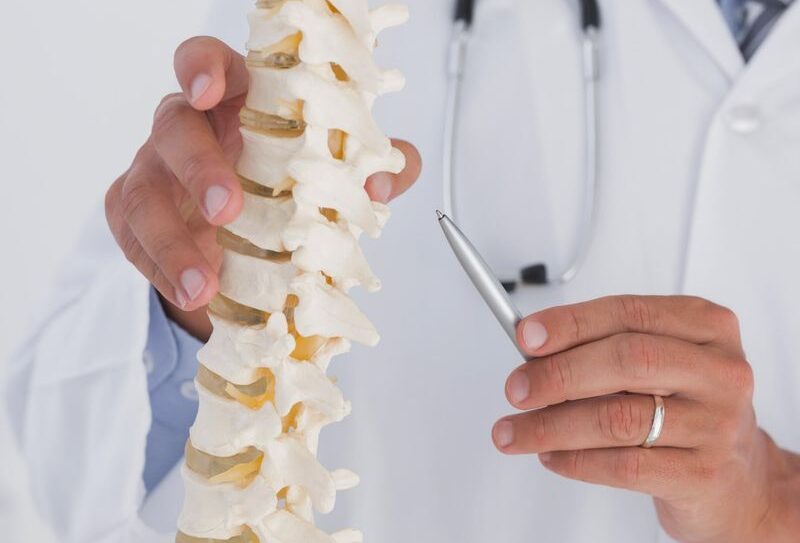
The lumbar spine contains five vertebrae, labelled L1 through L5. The L4-L5 disc sits between the fourth and fifth lumbar vertebrae.
Spinal discs have a tough outer layer surrounding a softer inner portion. With a disc bulge, part of the disc extends beyond its usual boundary.
An L4-L5 disc bulge may or may not cause symptoms. Some people have a bulge visible on an MRI but experience little or no pain. Symptoms are more likely when the bulging disc irritates or compresses nearby nerve structures.
Possible symptoms include:
- Lower back pain
- Buttock pain
- Pain extending into the leg
- Tingling
- Numbness
- Muscle weakness
- Stiffness
- Difficulty with prolonged sitting
The location and severity of symptoms are important when choosing exercises.
Can Exercise Help an L4-L5 Disc Bulge?
In many cases, appropriate exercise can be an important part of conservative treatment.
The goals of L4-L5 disc bulge exercises are not necessarily to physically push the disc back into its original position. Instead, exercise can help:
- Improve spinal mobility
- Strengthen muscles supporting the spine
- Improve core control
- Reduce deconditioning
- Improve posture and movement patterns
- Gradually restore normal physical activity
Exercise should generally be introduced progressively rather than through aggressive stretching or high-intensity workouts.
Best L4-L5 Disc Bulge Exercises
The following exercises may be appropriate for some people with an L4-L5 disc bulge. However, they should not be considered a universal treatment plan.
If an exercise increases leg pain, numbness, tingling, or weakness, stop and consult a healthcare professional.
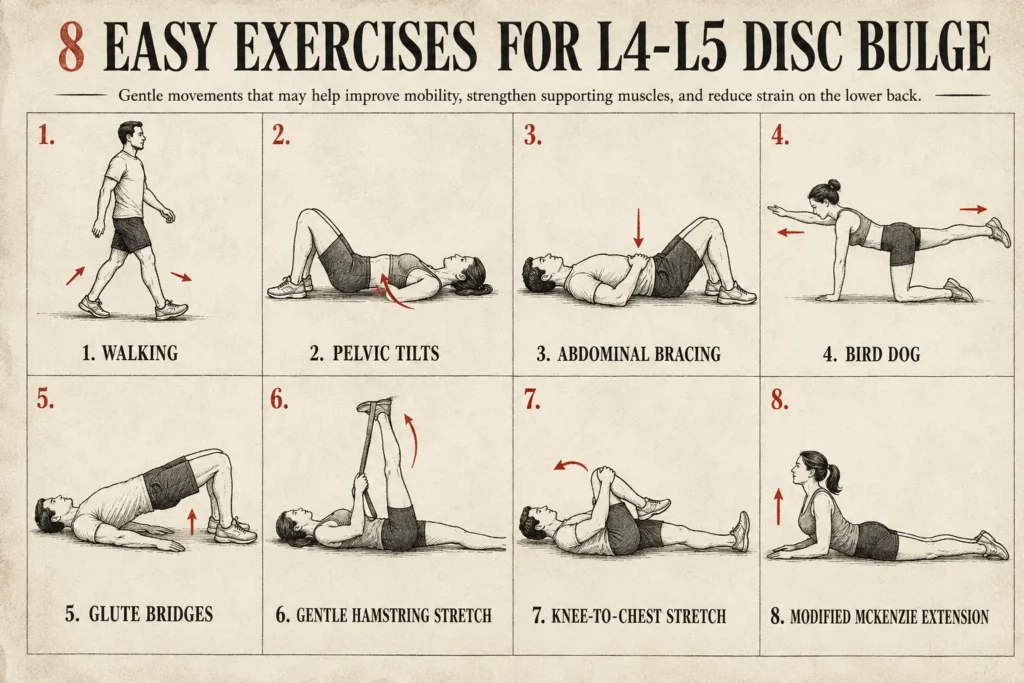
1. Walking
Walking is one of the simplest ways to remain active while recovering from a lower back problem.
Start with a comfortable duration, such as 5–10 minutes, and gradually increase the distance as tolerated.
Walking may help maintain:
- General mobility
- Cardiovascular fitness
- Leg strength
- Confidence with movement
Avoid forcing yourself to walk through severe or progressively worsening pain.
2. Pelvic Tilts
Pelvic tilts are gentle movements that can help improve awareness and control of the lower back.
How to perform them:
- Lie on your back with your knees bent.
- Keep your feet flat on the floor.
- Gently tighten your abdominal muscles.
- Flatten your lower back slightly against the floor.
- Hold for a few seconds.
- Relax and return to the starting position.
- Repeat slowly.
Perform the movement without forcing your back into an extreme position.
3. Abdominal Bracing
Abdominal bracing is useful for developing controlled core activation.
How to perform it:
- Lie down comfortably with your knees bent.
- Keep your spine in a neutral position.
- Gently tighten your abdominal muscles as if preparing for a light impact.
- Continue breathing normally.
- Hold the contraction for several seconds.
- Relax.
The goal is controlled muscle activation rather than maximum abdominal tension.
4. Bird Dog Exercise
The bird dog exercise works the core, back, and hip muscles while encouraging spinal stability.
How to perform it:
- Start on your hands and knees.
- Keep your back in a comfortable neutral position.
- Slowly extend one arm and the opposite leg.
- Avoid rotating your hips or arching your lower back.
- Hold briefly.
- Return to the starting position.
- Repeat on the opposite side.
Begin with a small range of movement if maintaining balance is difficult.
5. Glute Bridges
Strong gluteal muscles can help support efficient movement and reduce excessive reliance on the lower back.
How to perform them:
- Lie on your back with your knees bent.
- Keep your feet approximately hip-width apart.
- Tighten your abdominal muscles gently.
- Contract your buttocks.
- Lift your hips gradually.
- Stop before your lower back begins to arch excessively.
- Lower your hips slowly.
If bridging increases leg symptoms, stop the exercise and seek professional guidance.
6. Gentle Hamstring Stretching
Tightness around the back of the thighs can affect movement mechanics. Gentle stretching may help some people maintain flexibility.
How to perform it:
- Lie on your back.
- Raise one leg while keeping the other comfortable.
- Use a towel or strap if necessary.
- Gently straighten the raised leg until you feel a mild stretch.
- Do not force the knee straight.
- Hold briefly and return slowly.
A strong pulling sensation or worsening nerve symptoms means the stretch should be stopped.
7. Knee-to-Chest Stretch
A gentle knee-to-chest movement may improve lumbar mobility for some individuals.
How to perform it:
- Lie on your back.
- Bend one knee.
- Slowly bring it toward your chest.
- Hold gently.
- Return to the starting position.
- Repeat with the other leg.
This exercise is not appropriate for everyone. If it increases leg pain or other nerve-related symptoms, discontinue it.
8. Modified McKenzie Extension Exercises
Some people with disc-related lower back pain experience improvement with specific extension-based movements. These exercises are sometimes used in physiotherapy programs.
However, extension exercises can aggravate symptoms in certain individuals.
A physiotherapist should determine whether this movement pattern is appropriate based on your symptoms.
How Often Should You Do L4-L5 Disc Bulge Exercises?
There is no single exercise schedule suitable for every patient.
A common approach is to begin with short sessions and gradually increase activity as symptoms allow.
For example:
- Start with gentle movements
- Perform exercises with controlled technique
- Avoid exercising through worsening nerve symptoms
- Increase repetitions gradually
- Include walking or other comfortable physical activity
- Allow adequate recovery between more demanding sessions
Consistency is generally more important than performing a large number of repetitions.
Exercises to Avoid With an L4-L5 Disc Bulge
Not every exercise is appropriate during recovery.
Depending on your symptoms, it may be advisable to temporarily avoid activities involving:
Heavy Deadlifts
Heavy lifting places substantial demands on the lower back, particularly when technique breaks down.
Heavy Squats
Heavy squats may increase spinal loading and can aggravate symptoms in some individuals.
Repeated Deep Forward Bending
Repeated lumbar flexion may worsen symptoms for some people with disc-related pain.
High-Impact Activities
Running, jumping, or other high-impact movements may be uncomfortable during an acute flare-up.
Twisting Under Load
Exercises that combine rotation and heavy resistance can place additional stress on the lower back.
Sit-Ups and Aggressive Crunches
Repeated spinal flexion may aggravate symptoms in some patients.
The important point is that L4-L5 disc bulge exercises should be individualized. An activity is not automatically unsafe simply because it involves the lower back; its suitability depends on the person’s condition and symptoms.
Should You Exercise During a Disc Bulge Flare-Up?
Complete bed rest is generally not recommended for uncomplicated lower back pain.
Instead, maintaining comfortable movement is usually preferable.
During a flare-up:
- Reduce activities that clearly worsen symptoms.
- Take short walks if comfortable.
- Avoid prolonged bed rest.
- Use gentle movements rather than intense workouts.
- Resume strengthening progressively as symptoms settle.
If pain is severe, persistent, or accompanied by neurological symptoms, obtain medical advice before continuing an exercise program.
L4-L5 Disc Bulge Exercises for Sciatica
An L4-L5 disc bulge can sometimes irritate a lumbar nerve and cause symptoms that travel into the leg.
If you have sciatica, the response to exercise becomes particularly important.
A useful principle is symptom behavior.
If an exercise causes pain to move from the leg toward the lower back, this may sometimes be considered a favorable response. If pain begins to travel farther down the leg or numbness and weakness increase, the exercise may not be appropriate.
Because nerve symptoms can have different causes, this response should ideally be assessed by a physiotherapist or spine specialist.
When Should You Stop Exercising?
Stop an exercise and seek medical advice if you develop:
- Increasing leg pain
- New or worsening numbness
- New muscle weakness
- Difficulty walking
- Loss of coordination
- Severe pain that does not settle
These symptoms may indicate nerve involvement that requires further assessment.
Conclusion
The right L4-L5 disc bulge exercises can play an important role in improving mobility, rebuilding strength, and supporting a gradual return to normal activities. Walking, core stabilization, gentle mobility exercises, and progressive strengthening may be useful depending on your symptoms.
However, there is no single exercise routine that works for everyone with an L4-L5 disc bulge. If an exercise increases leg pain, numbness, tingling, or weakness, it should not be continued without professional guidance.
Most importantly, persistent pain or neurological symptoms should not simply be managed with home exercises indefinitely. A spine specialist or physiotherapist can determine the cause of your symptoms and develop an appropriate treatment and rehabilitation plan.
If your L4-L5 disc bulge is causing persistent back pain, sciatica, numbness, or weakness, consult a spine specialist for an accurate assessment and personalized treatment plan.





4 Responses